
TL;DR: World Cup logistics moves millions of licensed jerseys, plushies, and Trionda balls from Asian factories through US retailers like FIFA Store and Fanatics.
ShipToBox closes the last mile for international fans via DHL, FedEx, and UPS.
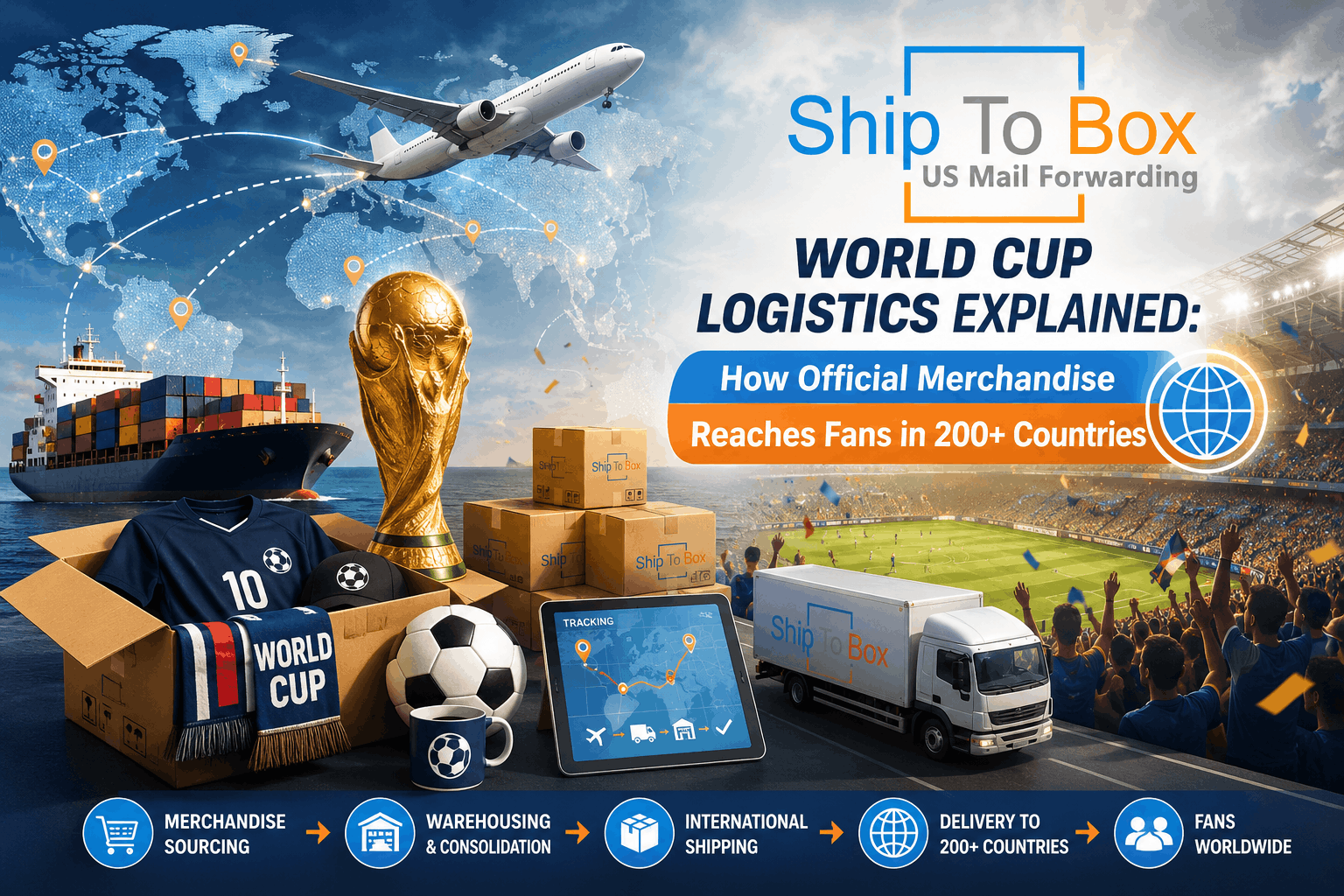
World Cup logistics is arguably the most complex short-window supply chain in modern consumer goods. In a matter of weeks — sometimes hours after a match ends — tens of millions of officially licensed jerseys, host city tees, mascot plushies, and Trionda match balls move from factories in Asia, through distribution hubs in the United States, out to fans in 200+ countries. Most of it lands within days. Most of it looks effortless from the outside. It isn’t. Behind every Messi jersey worn in Cairo, every host city tee unpacked in Lagos, every Trionda ball unboxed in Manila, sits a coordinated operation moving over one million pounds of equipment, 5,000+ specialized vehicles, and roughly one million square feet of dedicated warehouse space. Here’s how the 2026 FIFA World Cup logistics ecosystem actually works — and how international fans plug into it before stock runs dry.
The Scale of the Operation
A few numbers give a real sense of what’s happening behind the tournament this summer:
| Metric | Number |
|---|---|
| Global sports apparel market | $233.81 billion |
| Licensed sports merchandise market | $40.5 billion |
| Apparel share of licensed merchandise | 46.5% |
| Share of tournament distribution flowing through online channels | 61% |
| FIFA equipment moved | 1M+ pounds |
| Specialized vehicles deployed | 5,000+ |
| Dedicated warehouse space | ~1M sq ft |
| Competing nations | 48 |
| Matches | 104 |
| Host cities | 16 (11 in the US) |
| Tournament window | 39 days (June 11 – July 19, 2026) |
For context, the licensed sports merchandise market alone is roughly the size of the entire annual box office for global cinema. The 2026 tournament is the biggest catalyst in that market this decade — a 48-team, 3-country event featuring 62.5% more matches than Qatar 2022.
Where the Merchandise Actually Comes From
Every officially licensed FIFA 2026 jersey starts life in a factory somewhere across Asia, Latin America, or Europe — with production runs locked months before the tournament kicks off. adidas, Nike, and Puma — the three kit suppliers between them outfitting all 48 national teams — coordinate manufacturing across a network of contract facilities. Trionda balls, plushies, host city tees, scarves, and hats are similarly produced across specialized partners under FIFA’s licensing programme.
Once manufactured, the products travel by ocean freight to US ports — primarily Los Angeles/Long Beach, Houston, Miami, and New York — with customs clearance timed against tournament staging deadlines. FIFA’s Sustainability & Human Rights Strategy adds another layer, requiring low-carbon materials and responsible procurement standards for every SKU in the official merchandise supply chain.
The US as the 2026 Distribution Hub
Eleven of the sixteen host cities are in the United States. That single fact reshapes the entire sports merchandise supply chain for this tournament. Distribution centers have been pre-positioned near each venue cluster. Regional warehousing hubs feed the retail layer. And inventory is being staged across 16 host markets with flexible replenishment networks tuned for short lead times — because every match result rewrites the demand forecast for that team’s kits.
Argentina wins a knockout match? Restock the Messi jersey by tomorrow. Morocco pulls a shock upset? Puma-manufactured Atlas Lions kits fly out of stock at Fanatics within hours. This is what industry analysts call “bracket-driven replenishment,” and it’s why 3PL partners with real-time visibility have become indispensable to World Cup fulfillment.
The Retail Distribution Layer
Once merchandise lands in US warehouses, it flows into a well-defined retail layer:
- FIFA Official Store (store.fifa.com): Exclusive tournament-branded gear including host city collections, mascot merchandise (Maple, Zayu, Clutch), and the Trionda match ball.
- Fanatics: In December 2025, FIFA selected Fanatics as the official on-site retail licensee for the FIFA World Cup 2026 — meaning Fanatics runs stadium retail across all 104 matches and every Fan Festival location.
- adidas US, Nike US, Puma US: Direct-to-consumer channels for the federations each brand outfits (Argentina, Germany, Spain for adidas; USA, France, England, Brazil for Nike; Morocco, Senegal, Switzerland for Puma).
- Dick’s Sporting Goods, MLS Store, Soccer.com, Macy’s, Lids: Multi-brand catalogs and specialty retailers with distinct inventory positions.
Roughly 61% of tournament merchandise distribution now flows through online channels. That’s the mainstream number — but it hides an underlying reality: most of those online sales terminate at US addresses. Which brings us to the hardest part of the ecosystem.
The Last-Mile Challenge for International Fans
Here’s the friction point nobody at retail wants to talk about. The deepest inventory of officially licensed World Cup merchandise sits on US-facing e-commerce sites — the FIFA Store, Fanatics, adidas US, Nike US, Dick’s, Soccer.com. And most of those retailers either don’t ship internationally, ship to a limited country list, reject foreign-issued credit cards at checkout, or quote $40–$80+ in courier fees for a single jersey.
That’s the international sports shipping gap. Roughly two-thirds of global football fans live outside the US — Argentina, Brazil, Egypt, Morocco, Nigeria, Saudi Arabia, UAE, India, Bangladesh, Philippines, Mexico, and dozens of others. They want the same authentic gear, same limited editions, same Trionda balls. But the retail infrastructure isn’t built to serve them directly.
How Package Forwarding Closes the Gap
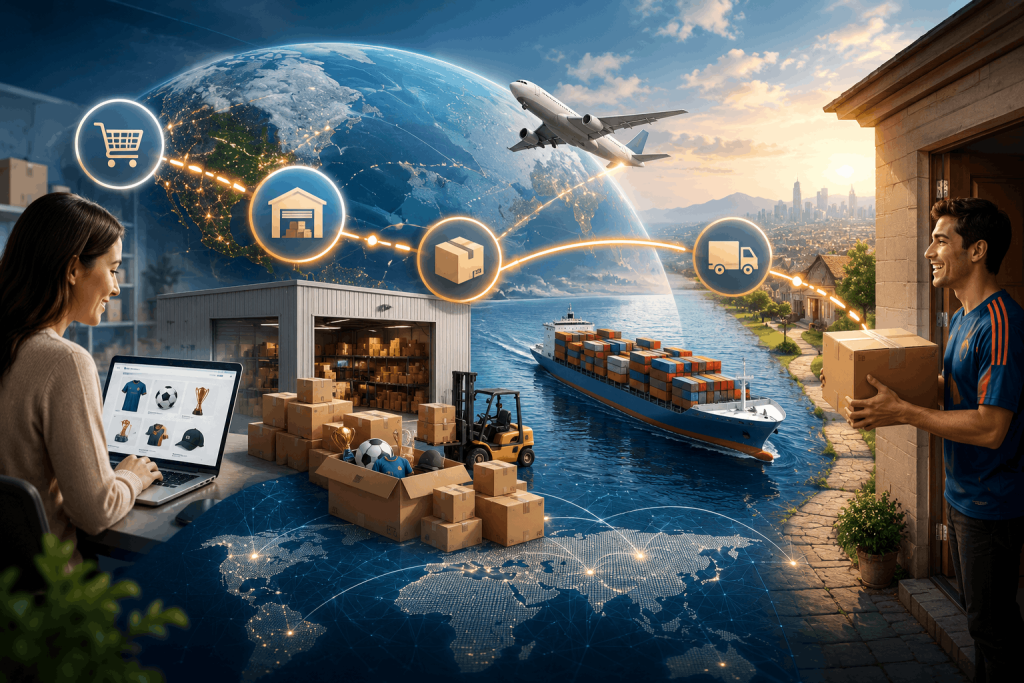
The workaround that’s grown up over the last decade is the package forwarding industry — services like ShipToBox that give international fans a US shipping address, receive purchases on their behalf, and ship the merchandise worldwide through carrier partnerships.
Here’s what ShipToBox specifically brings to the FIFA 2026 shipping equation:
- A free tax-free US shipping address. Warehouses in tax-free states save shoppers 7–10% in US sales tax automatically on every order.
- Package consolidation. Ordering a Messi jersey from adidas US, a Trionda ball from Dick’s, and a host city tee from the FIFA Store? Consolidation merges everything into one international box, cutting shipping bills by up to 80%.
- Buy For Me service for stores like Nike, adidas, and the FIFA Store that reject international payment cards.
- Multi-carrier flexibility. ShipToBox holds direct partnership rates with DHL, FedEx, and UPS — the three carriers that dominate global sports logistics.
The carrier choice actually matters more than most fans realize. DHL Express typically wins on Middle East and Asia routes (3–5 business days), FedEx International Priority leads for Europe and Latin America, and UPS Worldwide Expedited often offers the best speed-to-cost balance for Africa and Oceania. Being locked into one carrier — as many US retailers effectively force you to be — usually means paying more, waiting longer, or both.
Customs, Duty, and the Border Puzzle
FIFA’s own equipment moves through advanced customs pre-clearance pathways established years in advance — carnet agreements, temporary import permits, expedited borders. Consumer merchandise doesn’t get that treatment. Every jersey shipped to your country is subject to your country’s standard import duty and VAT rules, calculated based on declared value and product category.
Package forwarders help here too. Accurate customs documentation is standard practice for reputable services, meaning fewer flagged parcels, fewer surprise fees, and faster border clearance. But the duty itself — that’s still paid to your local customs authority on delivery. No workaround exists for that, no matter what forwarder you use.
Why This Matters for 2026 Fans

The 2026 World Cup is projected to draw billions of viewers and roughly five million in-person attendees. The merchandise category is the largest fan spending line for the tournament by a wide margin — during Qatar 2022, merchandise accounted for nearly half of daily fan expenses. That intensity is expected to be even higher for 2026 because the US soccer fan base outspends fans of any other major American sport on merchandise, and eleven host cities means eleven concentrated demand centers pulling stock through the retail network.
For international fans, that reality creates a two-track experience. Fans who plan ahead — grab their US shipping address, order early, consolidate their haul — get their gear in hand before kickoff. Fans who don’t often find their target kit sold out and their alternative retailers reject their card. The infrastructure exists to make the first scenario the norm. It just requires knowing the ecosystem.
FAQs About World Cup Logistics
How does FIFA ship merchandise worldwide?
FIFA doesn’t ship consumer merchandise directly. Licensed manufacturers produce it, US retailers sell it, and package forwarders like ShipToBox handle international delivery via DHL, FedEx, and UPS.
Where is World Cup merchandise manufactured?
Most jerseys and apparel are manufactured in Asia — primarily Vietnam, Thailand, China, and Indonesia — by contract facilities for adidas, Nike, and Puma. Balls and accessories come from FIFA-licensed partners.
Who handles FIFA World Cup 2026 logistics?
Rock-it Cargo is FIFA’s Official Logistics Provider, appointed in 2024. Fanatics runs on-site retail across all 104 matches and every Fan Festival location.
How long does World Cup merchandise take to ship internationally?
Via a package forwarder, expect 3–5 business days on DHL Express, 4–7 days on FedEx International Priority, or 5–9 days on UPS Worldwide Expedited.
Can I ship World Cup merchandise to any country?
Yes. Services like ShipToBox provide a US shipping address, receive purchases from any US retailer, and forward them to 200+ countries via DHL, FedEx, and UPS.
Why is 61% of tournament merchandise sold online?
E-commerce enables real-time replenishment as teams advance, deeper inventory, and faster access to new drops than physical retail can provide.
How do package forwarders help World Cup fans?
They solve four core problems: retailers that don’t ship internationally, foreign cards rejected at checkout, brutal courier fees, and the inability to consolidate purchases from multiple US stores.
What is Rock-it Cargo’s role in the FIFA World Cup 2026?
Rock-it Cargo is FIFA’s Official Logistics Provider for 2026. It handles freight, customs clearance, warehousing, venue logistics, and team equipment movement across all 16 host cities in the US, Canada, and Mexico.
Are FIFA World Cup logistics different from regular retail logistics?
Yes. Every match result rewrites demand — Argentina wins a knockout tie, Messi jerseys need restocking by morning. Regular retail rarely faces that level of forecast volatility.
Do I pay customs duty on World Cup merchandise?
Yes, in most countries. Duties and VAT are calculated on the declared value and product category. Package forwarders provide accurate documentation, but you pay any duty to your local customs authority on delivery.
Final Whistle
World Cup logistics is unlike anything else in global consumer goods. A 39-day window. 48 nations. 104 matches. 5,000+ specialized vehicles. A million square feet of warehouse space. And the whole thing pivoting in near-real time whenever a team advances or crashes out. That’s the picture behind every jersey a fan wears to their local watch party — and behind every Trionda ball that lands at a fan’s door in São Paulo or Riyadh or Accra.
The retail infrastructure that supports that global demand runs primarily through US-based e-commerce, and the last mile to international fans runs through package forwarders like ShipToBox and their carrier partnerships with DHL, FedEx, and UPS. If you’re outside the US and you want to own a piece of this tournament, open a free ShipToBox account, grab your tax-free US shipping address, and let the ecosystem do what it’s built to do. The gear won’t wait.