
You’ve finally found the perfect product on a US website. The price is great. Then you check the shipping cost — and suddenly that bargain isn’t a bargain anymore. Sound familiar? If you shop from American retailers and live anywhere outside the United States, you’ve probably been there more times than you’d care to admit.
Here’s the good news: most international shipping costs aren’t set in stone. They’re shaped by choices — the address you ship to, the way your packages are bundled, the carrier you pick, even the timing of your order. A few smart moves can shrink your total bill dramatically. The international shipping tips below are the same ones experienced cross-border shoppers use to keep more money in their pockets without giving up the products they love.
Let’s get into it.
Table of Contents
Tips That Actually Save You Money
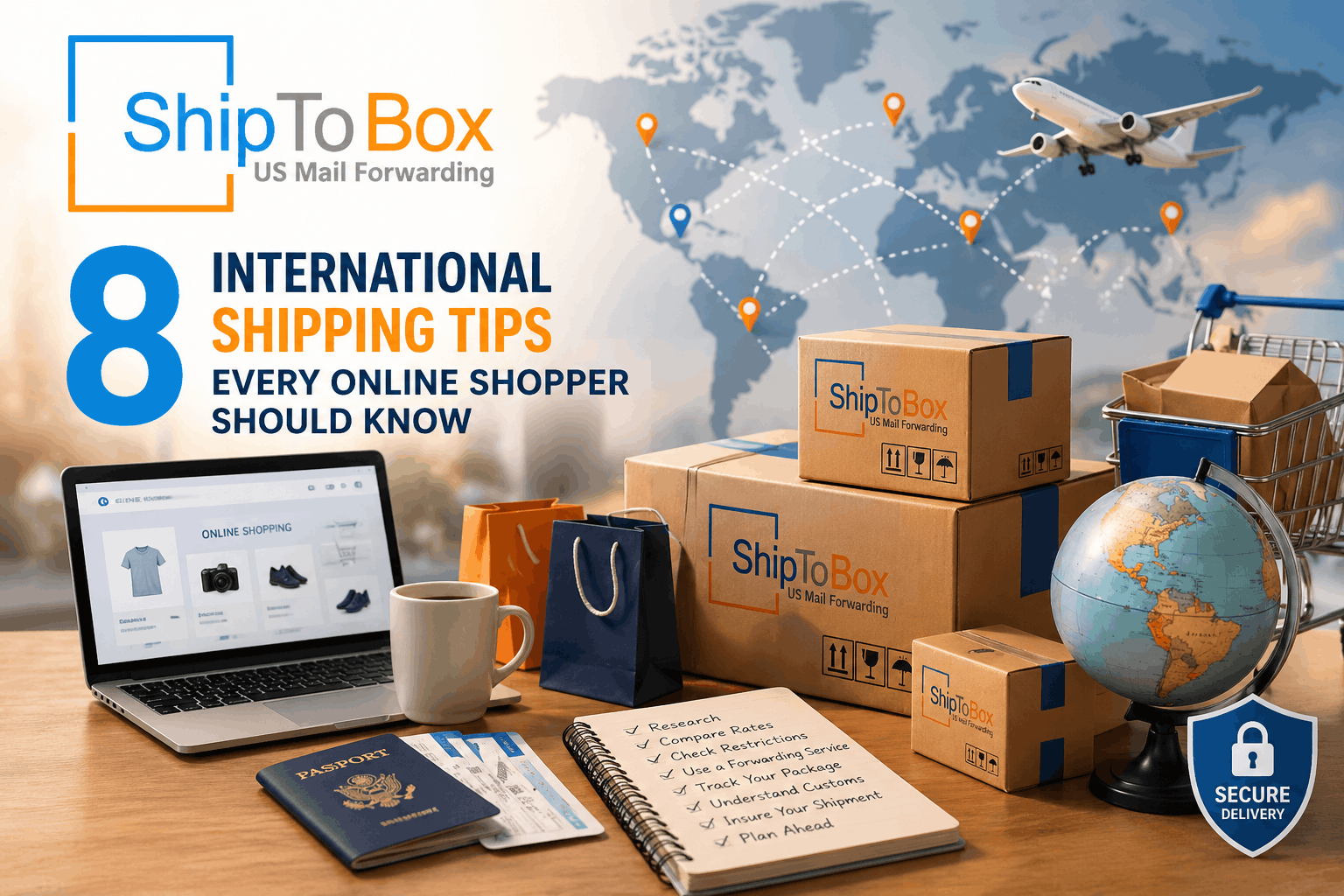
Cross-border shopping has its own learning curve. Most first-time international buyers overpay simply because nobody told them where the leaks are. The eight international shipping tips below cover the full journey of an order — from the moment you click buy in a US store, to the moment your package lands at your door. Apply even a handful of them, and the savings add up fast.
1. Use a US Package Forwarding Service Instead of Paying International Shipping at Checkout
This is the single biggest lever you have. When a US retailer ships internationally, they typically tack on an inflated rate (sometimes double or triple what the carrier actually charges). With US package forwarding, you get a real American address to use at checkout. Your purchase ships domestically — cheap and fast — to a warehouse like ShipToBox, and from there it goes to your country at a heavily discounted international rate.
The savings? Often 40–70% compared to the retailer’s own international shipping option. And many stores that flat-out refuse international orders (think Best Buy, Target, certain Amazon sellers) suddenly become accessible.
2. Always Consolidate Packages Before They Ship

If you order from three different stores in one week, you don’t want three separate international shipments. That’s three sets of fees, three sets of fuel surcharges, three customs filings. Instead, let your forwarder hold your packages and combine them into one box.
Consolidate packages international shipping is where the real savings live — sometimes up to 80% off versus shipping each item individually. Carriers charge based on weight and volume, and combining multiple small parcels into one larger one almost always works in your favor. ShipToBox offers free consolidation, which means you can stack up purchases from your favorite US stores and only pay to ship once.
3. Pay Attention to Dimensional Weight, Not Just Actual Weight
Here’s a sneaky one that catches almost every new international shopper off guard. Carriers like DHL, FedEx, and UPS don’t just charge based on how heavy your package is — they also charge based on how much space it takes up. This is called dimensional weight shipping (or DIM weight).
A pillow weighs almost nothing, but it occupies a huge box. Guess which one you’ll get billed for? The bigger of the two numbers. So when you’re shopping, think twice about bulky-but-light items, and ask your forwarder if they offer repackaging — squeezing your stuff into a smaller box can quietly knock 20–30% off the bill.
4. Pick the Right Forwarding Address to Avoid US Sales Tax
Not every US state charges sales tax. Oregon, Delaware, Montana, New Hampshire, and Alaska are the famous five with no statewide sales tax. If your forwarder has a warehouse in one of these states, you can effectively avoid US sales tax international shopping fees entirely — that’s a clean 6–10% saved before shipping even enters the picture.
For a $500 electronics order, that’s $40+ kept in your pocket just by choosing the right address. Stack this with consolidation and you’re looking at meaningful money saved on every order.
5. Compare Carriers — They’re Not All Equal for Every Country
DHL might be cheapest to your country. Or FedEx. Or UPS. There’s no universal answer, and anyone who tells you otherwise is guessing. ShipToBox partners with DHL, FedEx, and UPS, which means you’re not locked into one carrier — you can compare live rates at checkout and pick whichever option makes sense for your shipment’s weight, destination, and urgency.
A small parcel headed to Bangladesh might ship cheapest via DHL, while a heavier box bound for Brazil could be 30% cheaper through FedEx Economy. Always check. Don’t assume.
6. Time Your Purchases Around US Sales Events
Black Friday, Cyber Monday, Memorial Day, July 4th, Back-to-School, and post-Christmas clearances are when American retailers slash prices to levels you simply won’t see in your local market. Combining a deep US discount with cheap shipping from USA via consolidation is how serious cross-border shoppers build whole wardrobes, gaming setups, or skincare stashes for less than the local equivalent of one item.
The trick: don’t ship immediately. Order during the sale, let everything land at your forwarder’s warehouse, and ship once when the dust settles.
7. Watch Out for Restricted and Hazmat Items

Lithium batteries, perfumes, aerosols, certain electronics, supplements — these get flagged as hazardous materials and can either trigger huge surcharges or be rejected outright. Check your forwarder’s prohibited items list before you click buy, not after. ShipToBox publishes a clear list of what can and can’t fly, and so do all reputable forwarders. Five minutes of homework saves a refused shipment and a headache.
8. Factor In Customs Duties and Plan Around Them
Here’s a tip many shoppers learn the hard way. Your country’s customs office may charge import duties and VAT/GST on goods above a certain value threshold (this is called the de minimis). Ship a $50 parcel and you might pay nothing. Ship a $500 parcel and your customs bill could add 15–30% to the total cost.
Strategies that help: shipping multiple smaller parcels under the threshold (where legal), declaring values accurately, and using carriers like DHL that often clear customs faster. For a deeper dive, the World Customs Organization’s resources are genuinely useful reading if you’re a regular international shopper.
People Also Ask
What is international shipping?
International shipping is the process of sending packages from one country to another through carriers like DHL, FedEx, or UPS. It involves customs clearance, duties, and longer delivery times than domestic shipping.
How long does international shipping take?
Most international shipments arrive within 3–10 business days. Express services like DHL Express or FedEx International Priority can deliver in as little as 2–4 days, while economy options may take 7–14 days.
What is the cheapest way to ship internationally from the US?
The cheapest way is to use a US package forwarding service that consolidates multiple orders into one shipment. This single move can cut your international shipping costs by up to 80%.
What is package forwarding?
Package forwarding is a service that gives you a US address to receive online purchases. The service then ships those purchases to your country, often at much lower rates than the retailer offers.
What is package consolidation?
Package consolidation means combining multiple parcels into one larger shipment before sending them internationally. It saves money because you pay one shipping fee instead of several.
Do I have to pay customs duties on international orders?
It depends on your country’s rules and the value of your shipment. Most countries have a duty-free threshold (de minimis), and orders below that limit usually clear customs without extra charges.
Can I ship from US stores that don’t ship internationally?
Yes. With a US package forwarding address from ShipToBox, you can shop at any US store — including those that don’t ship abroad — and have your purchases forwarded to your country.
What is ShipToBox?
ShipToBox is a US package forwarding service that gives international shoppers a free US shipping address. We receive your packages, consolidate them, and ship them worldwide using DHL, FedEx, and UPS.
Is ShipToBox free to sign up?
Yes. Signing up for a US shipping address with ShipToBox is completely free. You only pay when you ship a package out.
Which carriers does ShipToBox use?
ShipToBox partners with DHL, FedEx, and UPS, giving you flexibility to choose the carrier that offers the best rate and delivery speed for your destination.
How long can ShipToBox store my packages?
ShipToBox offers free storage for a generous window after your package arrives, giving you plenty of time to consolidate multiple orders before shipping them out together.
Can ShipToBox ship to my country?
ShipToBox ships to over 200 countries worldwide. If your country is reachable by DHL, FedEx, or UPS, we can deliver there.
Does ShipToBox handle Amazon orders?
Yes. You can ship Amazon US orders to your ShipToBox address — including Amazon-only deals and items that Amazon won’t ship internationally.
What items can’t I ship internationally?
Common restricted items include lithium batteries, aerosols, perfumes, alcohol, weapons, and counterfeit goods. Always check the prohibited items list before placing an order.
How do I track my international shipment?
You’ll get a tracking number once your package leaves the warehouse. You can track it directly through the carrier’s website (DHL, FedEx, or UPS) or inside your ShipToBox dashboard.
Is international package forwarding safe?
Yes. Reputable forwarders like ShipToBox operate from secure warehouses, photograph every package on arrival, and use trusted carriers with full tracking and insurance options.
Can I save US sales tax with package forwarding?
Yes. By shipping to a forwarder located in a sales-tax-free US state, you can legally avoid US sales tax on your purchases — saving 6–10% on most orders.
Final Thoughts
Smart international shopping isn’t about luck — it’s about knowing the system. These international shipping tips work because they tackle every layer of the cost stack: the retailer’s markup, the tax bite, the carrier’s pricing model, and the customs hit at the other end. Apply even three or four of them on your next order and the difference will surprise you.
If you’re ready to put these international shipping tips into practice, the easiest starting point is signing up for a free US shipping address with ShipToBox and routing your next purchase through it.